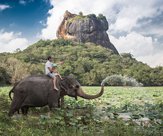
Sigiriya (The Lion Rock), also known as the ‘Palace and Fortress in the sky’, was built by King Kassapa (477 – 495 AD). Sigiriya Rock Fortress Sri Lanka is a UNESCO World Heritage Site and located in the central district of Matale close to the town of Dambulla.
The Sigiriya Rock Fortress Sri Lankacomplex is considered one of the best preserved examples of ancient urban planning, The fortress is outlined with a web of gardens, tanks and structures.
Kashyapa the Rebel King
King Kashyapa (also known as Kasyapa I or Kassapa), was the eldest son of King Dhatusena, by a palace concubine. As legend goes, King Dhatusena was overthrown and walled in, alive by Kashyapa in 473 AD. Mogallana, Dhatusena’s son by the true queen fled to India, vowing revenge. Fearing retribution, Kashyapa built this impregnable fortress at Sigiriya and sought salvation from his brother’s vengeance
When the invasion finally came in 491, Kashyapa rode out to battle in his war elephant. In an attempt to out-flank his half-brother, Kashyapa took a wrong turn, where his elephant got stuck in the mud. His soldiers, thinking Kassapa was retreating fled, abandoning him, and Kassapa took his own life.
Sigiriya later became a monastic refuge, but eventually fell into disrepair.
The Gardens
The beautifully and elaborately landscaped gardens are divided into 3 sections;
- The water Gardens,
- The Boulder Gardens and
- The Terraced Gardens
Although distinct, the gardens are also linked.
The Water Gardens contain a complex underground water distribution system. The network provides water to the Royal baths, the many little moated islands & fountains. Some fountains still work during the rainy season! A superb view of the Gardens could be had from halfway up the rock.
The Boulder Garden consists of collection of strategically placed large rock connected by a network of winding paths. Most of the boulders had pavilions with brick structures built on them. The boulders were not only aesthetically pleasing, but also acted as a defense against enemies. The boulders could be pushed off on enemies below at short notice.
The Terraced Garden is a stepped garden that rises from the boulder garden. The terraced garden is designed in a rough circular formation around the rock.
Frescoes – The Sigiriya Damsels
About halfway up the rock is a sheltered gallery of frescoes painted on the sheer rock face. The ‘Heavenly Maidens’ are similar in style to the paintings of Ajantha in India. Some of them are still in remarkably good condition. Only 22 out of an estimated 500 pictures now remain. Flash photography is not allowed at this site.
The Mirror Wall with Graffiti
Beyond the fresco gallery, the pathway circles the sheer face of the rock, and is protected by a 3m high wall. This wall was coated with a mirror-smooth glaze, in which visitors over 1000 years ago noted their impressions of the women in the gallery above. The graffiti was mostly inscribed between the 7th and 11th Century AD. 685 of them have been deciphered and published. The graffiti are a great source for the scholars to study the development of the Sinhala language and script.
Lion Platform
The Northern end of the rock the pathway emerges to a platform, from which the rock derives its name Sigiriya (the Lion Rock). At one time a gigantic brick lion sat at the end of the rock, and the final ascent to the summit was between the lions paws and into its mouth! Today the lion has disappeared, only the paws and the first steps are visible.
The Summit
Covering an area of around 1.6 hectares, the remains of the foundations show that the summit would have been completely covered with buildings. The design, layout and magnificent views that it still enjoys to this day, suggest Sigiriya would have been more of a royal palace of pleasure than a fortress. A pond scooped out of solid rock measuring 27m x 21m, looks like a modern rooftop pool. A smooth slab of flat stone, often referred to as the kings stone throne, faces the rising sun.